Side project · Small business

WhatsApp Assistant

A bot that knows when to be quiet. It answers the repeated questions of a one-person dry ice shop, covers after hours, and steps aside the moment the owner replies.

Designer and builderMay 2026Live

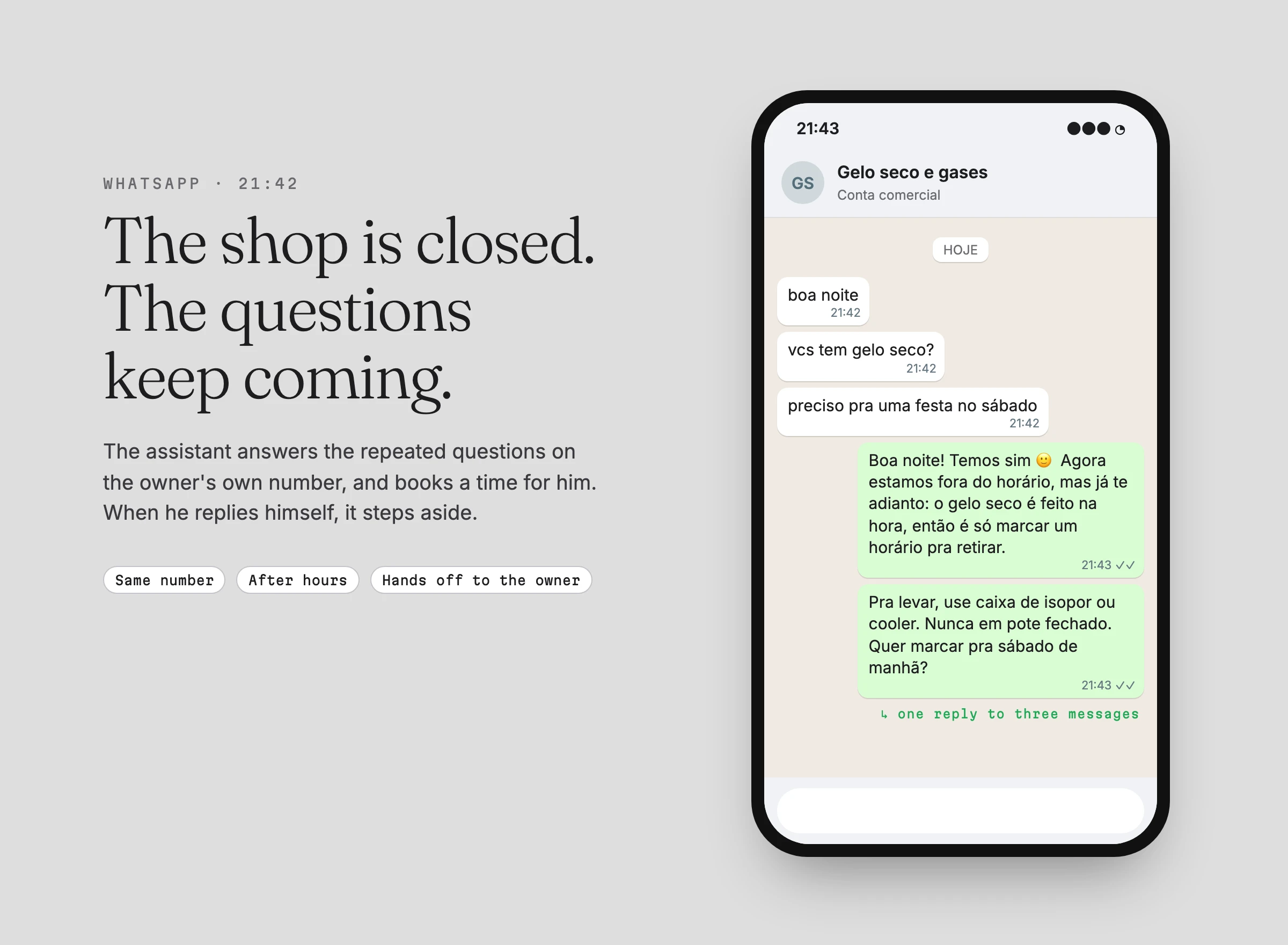
A WhatsApp chat at 21:42: a customer sends three short messages about dry ice and the assistant answers once, outside business hours
OverviewA reconstruction: a customer writes at night, and the assistant answers three messages with one reply.

The problem

The same questions, at all hours

A family business makes dry ice to order and sells industrial gases. The owner works alone. Customers ask the same things on WhatsApp: how it is sold, how to carry it, when to pick it up. They ask at night and on weekends too, and every answer takes him away from production.

The same number is also his personal WhatsApp. Friends and family write to it.

The real problem. Answer the repeated questions without taking the phone away from the owner, and without ever talking to someone who did not ask.

My role. I designed the flow, the rules and the voice, and built it in n8n, with Claude as a pair for the code. The owner gave the answers, the tone and the feedback from real conversations.
Decision 1

Same number, same phone

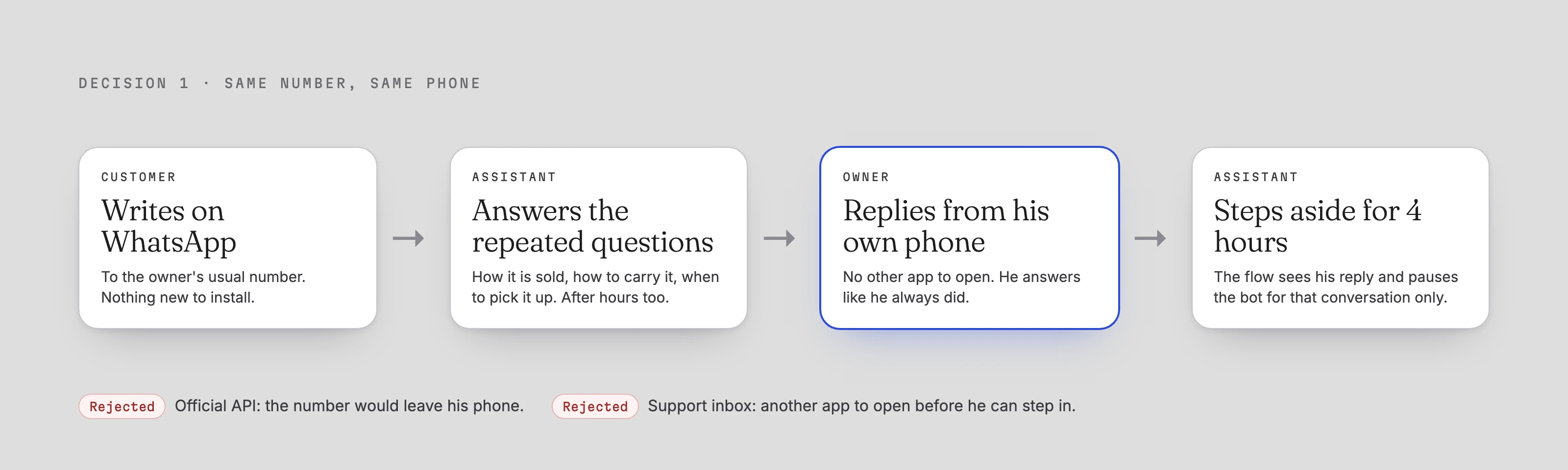
The official WhatsApp API would have moved his number off his phone. A support inbox would have meant opening another app before he could step in. Both were rejected for the same reason: he has to answer from his own phone, the way he always has.

The assistant runs as a linked device on his existing account. When he replies to a customer himself, the flow sees it and pauses the bot for that conversation for four hours.

Four steps: the customer writes, the assistant answers, the owner replies from his own phone, and the assistant steps aside for four hours. Below, the official API and a support inbox are marked as rejected.
Hand-offThe owner takes over by replying. No other app, no switch to flip.

Decision 2

People write in pieces

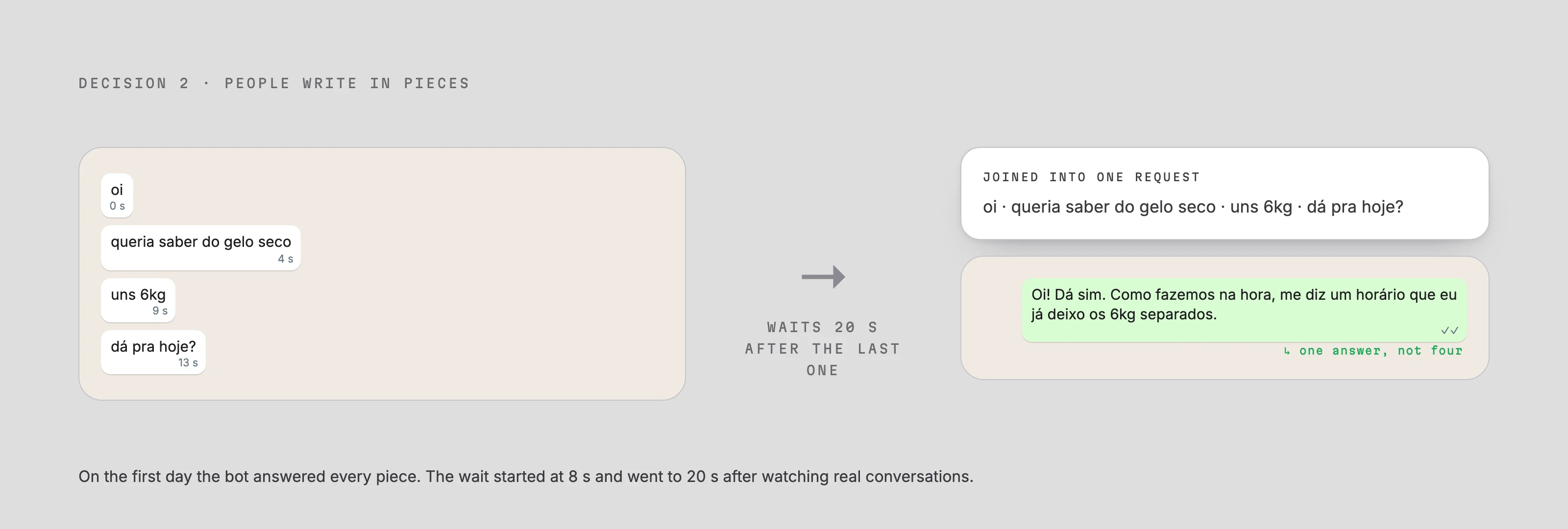
On the first day a customer sent one order as several short messages, and the bot answered each one. On WhatsApp, people rarely write one complete message.

Every message now goes into a queue. The flow waits, and only the last message of a burst gets an answer, with all the pieces joined into one request. The wait started at 8 seconds and went to 20 after watching real conversations.

Four short messages sent over 13 seconds are joined into one request after a 20 second wait, and the assistant sends one answer
DebounceFour messages, one answer. A reconstruction with no real customer data.

Decision 3

Sound like him, not like a bot

The voice came from the owner’s own messages: informal and welcoming. The assistant greets a customer once a day, keeps the context of the day’s conversation, and asks the customer to book a time, because the owner works alone and makes the ice to order.

It never invents an answer. What it does not know, or what needs the owner, goes to him.

Decision 4

Know when to stay out

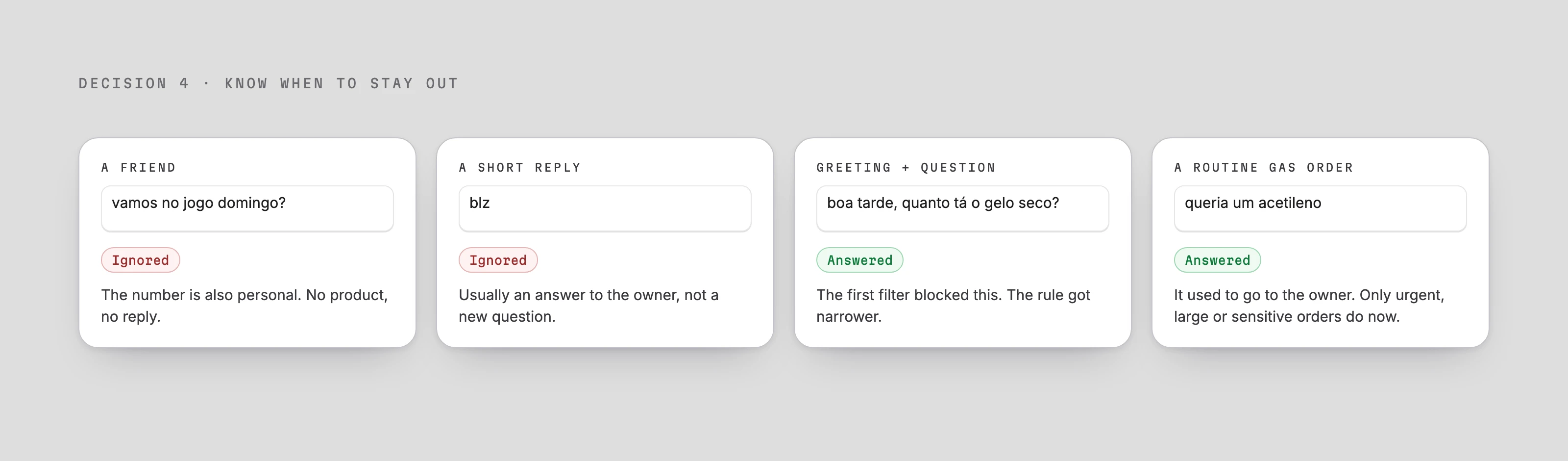
Because the number is personal, the assistant only joins a conversation about the products. The first filter was too strict: it ignored a greeting followed by a price question, because it blocked greetings. The rule got narrower. A short reply on its own, like “ok”, is ignored. A greeting with a question goes through.

The hand-off had the same problem in reverse. A routine gas order was sent to the owner as if it were a complex case. The rules were narrowed to what really needs him: urgent orders, large quantities and sensitive uses.

Four example messages: a friend’s message and a short reply are ignored; a greeting with a question and a routine gas order are answered
FilterWho gets an answer, and who does not. Example messages, not real ones.

Build

Small stack, one cost decision

WhatsApp through a linked device, n8n for the flow, PostgreSQL for the queue, the conversation state and the memory of the day, all hosted on Railway.

The model. The first version used Claude Haiku. I switched to DeepSeek to keep the running cost low for a small shop. The prompt and the rules stayed the same.

An incident. In the second week the database disk filled up, the service went down, and the latest workflow was lost. I rebuilt it from the saved files.

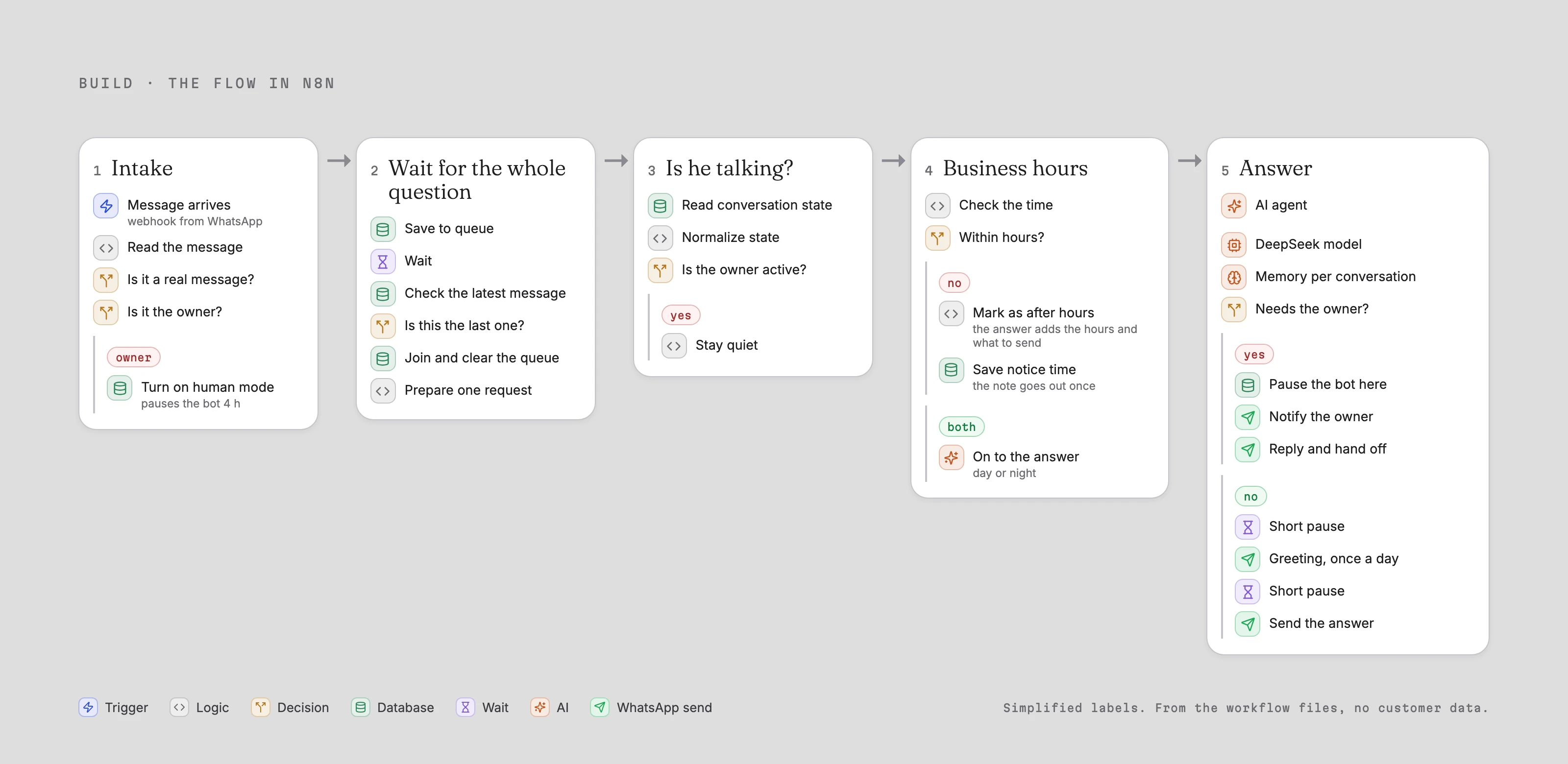
The n8n workflow in five stages: intake, waiting for the whole question, checking if the owner is talking, business hours, and the answer, with the AI agent, its model and memory, and the hand-off branch
WorkflowThe flow, grouped in five stages. After hours it still answers, and adds the opening hours once. Labels simplified.

Outcome

A first reply in 25 seconds, at any hour

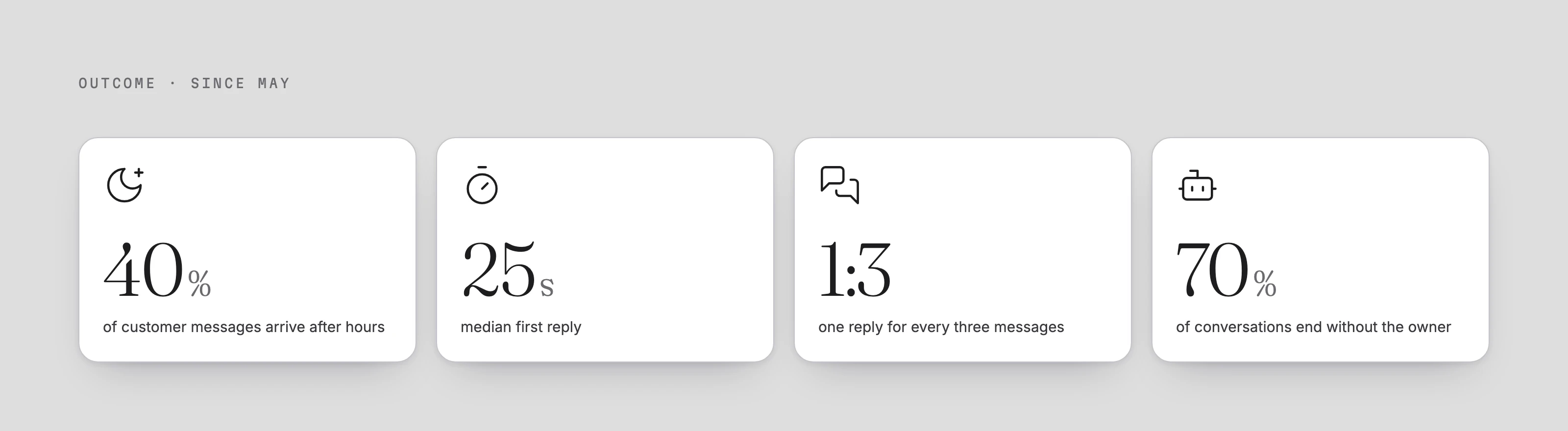
After hours. 40% of customer messages arrive outside business hours. Before, those waited until the next morning.

First reply. The median first reply takes 25 seconds, day or night. Most of that is the deliberate wait for the customer to finish typing.

Fewer, fuller answers. On average the assistant sends one reply for every 3 customer messages, because it waits for the whole question.

Without the owner. 70% of conversations end without him stepping in. The rest are the cases the rules send to him on purpose: urgent orders, large quantities, sensitive uses.

A note on the images. The chats on this page are reconstructions. They follow the real flow, without real names, numbers, prices or customer messages.

Four results: 40% of messages arrive after hours, 25 second median first reply, one reply for every three messages, 70% of conversations end without the owner
ResultsSince May 2026.

What I learned

The hard part was silence

Most of the work was not about answers. It was about when the bot should not speak: split messages, short replies, a personal number, an owner who had just taken over.

And keep the flow in version control. When the disk filled up, the latest workflow existed only inside the tool. Next time it goes into git from day one.